Tuesday, 2nd of December, 2025
Hidden (and Not So Hidden) Gems of Athens
Athens. The capital of Greece. One of the ancient epicentres of the world. If beach holidays come to mind when you hear “Greece”, I apologise. This blog post will be inspired by the beautiful art and history of the country based on my academic visits to the city. So, if you are interested in digging deeper into Greek history and culture, páme!
Depending on your age and when you visited Athens, we may have different interpretations of what the modern city looks like. Let me help set the stage. It is 2022. The city is relatively calm as it slowly emerges from the worst of the pandemic. Both within a group and as an individual, the city is easy to navigate and explore. The Greek alphabet all around does not scare me even though I only know a handful of words in Greek. Instead, I have started to think of it as a matching game. Bit by bit, I am able to detect familiar words.

On each of my two visits to the city, I oriented myself in relation to the Acropolis. There was a comfort in seeing the remnants of the Parthenon in the distance from many parts of the city, as it helped me keep oriented in my cognitive map. If I ever got lost, I could always walk towards the Parthenon and restart my walk towards point B.
The city itself is similar to Rome in that the city juxtaposes classical ruins, with neo-classical modern architecture, alongside steel and glass buildings. Popular streets hold entrances to smaller, cozy communities with delicious food just a stone’s throw away from ancient marvels. Of course, if you want a view of the Parthenon, there is always a restaurant or a rooftop to accommodate that wish.
As an obvious attraction to visit, I recommend climbing and visiting the Acropolis in Athens. The site not only includes the Parthenon, but also a handful of buildings that creates a layered city complex. The site dates back to the 13th century including influences from the Mycenaeans, ancient Greeks, and Romans. The site was later inhabited by the Ottoman Empire, which included the destruction of the Parthenon when it was unfortunately used as an ammunition storage centre. Since the 19th century, there have been several efforts to restore the area, especially the Parthenon.

To learn more about the area as you walk up and through the Acropolis, I suggest using Rick Steve’s Audio Tour. This helped me to orient myself as I walked from one level to the next, and learn about structures I didn’t even know existed here, such as the Odeon of Herodes. In addition, Rick provides mytho-historical context to sites, including the Erechtheion.

The Parthenon itself is a gorgeous marvel comprised of white panhellenic marble. Once a temple to the goddess Athena, and a hub of religious activity, the building’s remnants still stand tall over the city of Athens commanding praise for its architectural might. If you look closely, you may be able to see that all of the columns are bulging slightly to create the illusion that the building stands up straight, thanks to the architectural planning of Iktinos and Kallikrates.

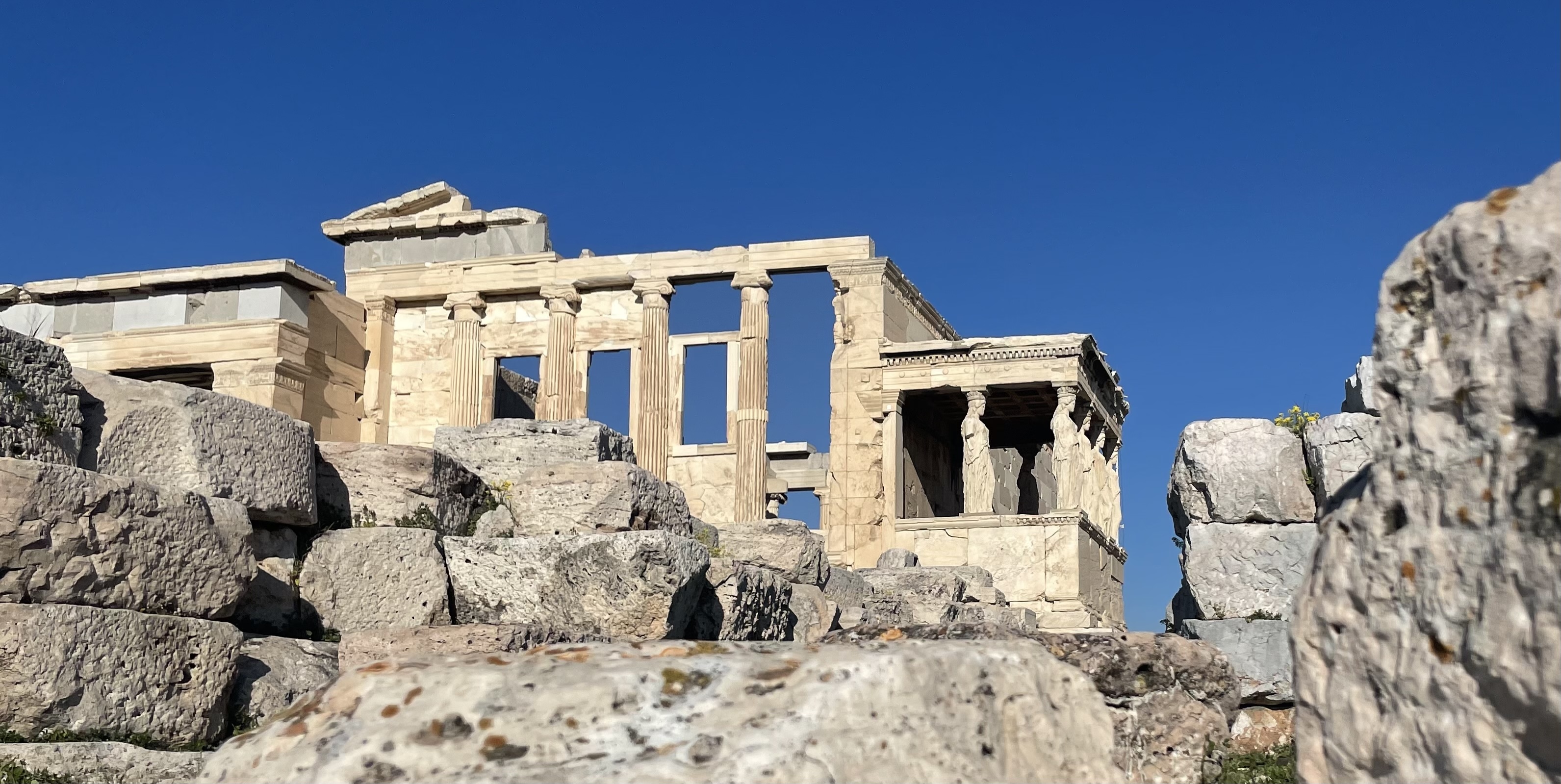
Behind the Parthenon is the Erechtheion, which served as another temple complex. The most iconic part of the marble building is the porch containing replicas of the original six caryatids which now gaze out at the thousands of tourists that mill about here. Hidden from the naked eye is the fascinating mytho-history involving Poseidon, Athena, and the olive tree around the corner.

For those interested in a closer look of the original caryatids from the Erechtheion, and the triglyphs and pediments from the Parthenon, I would make sure to pencil in time at the Acropolis Museum at the base of the Acropolis. This is not so much as a hidden gem, as it is right next to the site, but I feel that people would skip this place with the mindset of “why go to the museum when the original building is right here”. Well… inside the museum is centuries worth of artifacts found at the Acropolis, including five out of the six caryatids and a handful of the sculptures from the Parthenon (the other caryatid and many of the other marbles are currently in the British Museum).
Perhaps my favourite part of the museum is the third floor. Here, there is a selection of projections showing how the Parthenon would have looked in its original state - in colour. After watching these projections, I walked through a set of doors into an open glass room with reliefs from the Parthenon laid out in the same orientation as they were originally. Even more spectacular, this exhibit provided a view of the Parthenon itself diagonally above me. The exhibit planning was extraordinary and made me feel like I could envision the temple in its original glory.

If museums happen to be your fancy, I have two more to recommend. The more well known one is the National Archaeological Museum for its incredible bronze and marble statues, but more importantly (at least to me), its Bronze Age collection. If you read “the Bronze Age” and thought that only metal objects would be on display, I would not blame you. Though, I would like you to try and picture sets of frescoes, ones including delicately painted fish, flying birds, gazelles, and leaping bulls, painted over 3000 years ago! The sheer beauty and talent these artists had, three millennia ago even, is incredulous and has carefully conserved. Your mind will be changed, just as mine was, about Greece’s history once you gaze upon their collection.
My other museum suggestion dives deeper into the Bronze Age, as well as explores the history of the Greek Islands; The Museum of Cycladic Art. White marble statuettes in varying poses paired with numerous types of tools stand tall despite being over 5000 years old! A whole culture’s history remains to be uncovered as these statues wait in silence for their stories to be told. On other levels, there are equally fascinating exhibits and displays that delve into ancient Greek life, customs, and careers. In my opinion, this institution was great in filling in gaps and questions I had about Greece’s long history.

If museums are not your cup of tea, I suggest you take a hike… Quite literally. In some of my downtime in Athens, I hiked around to see different views and parts of the city. For example, I climbed the Philopappos Hill and came across numerous sites. T hey included the Philopappos Monument, the Prison of Socrates, the Dipylon Above the Gates, Sanctuary of Pan, and a breathtaking view of the Acropolis. Nearby this hill, for a less strenuous walk, there is the ancient Greek Agora, the Roman Forum, and a handful more ruins in the nearby vicinity. If you decide to wander aimlessly around the city, you are bound to trip over some history along the way. Just keep your eyes peeled.

Once again, I would like to admit that this is not a comprehensive list of places you can visit while in Athens. I still have to visit the Olympic Stadium, the nearby beaches, and more. This was just a curated list of some of the places I visited for class and my thesis research during my master’s program. Eventually, I will make my way back to Athens again to explore more of the city.
Thank you for reading, and until next time.
For my art historians, classicists, museum goers and art lovers, I have a tip before you travel to Greece, or any major museum/historical location. I would look into applying for the ICOM card (International Council of Museums). I am not sponsored by them, but they are a great organisation supporting the research and conservation of our global cultural history. The ICOM card was especially great in Greece as almost every major museum and archaeological site provided free admission with this card, though it is useful in many other countries as well. The application may take a couple of months to process, so please plan accordingly.
